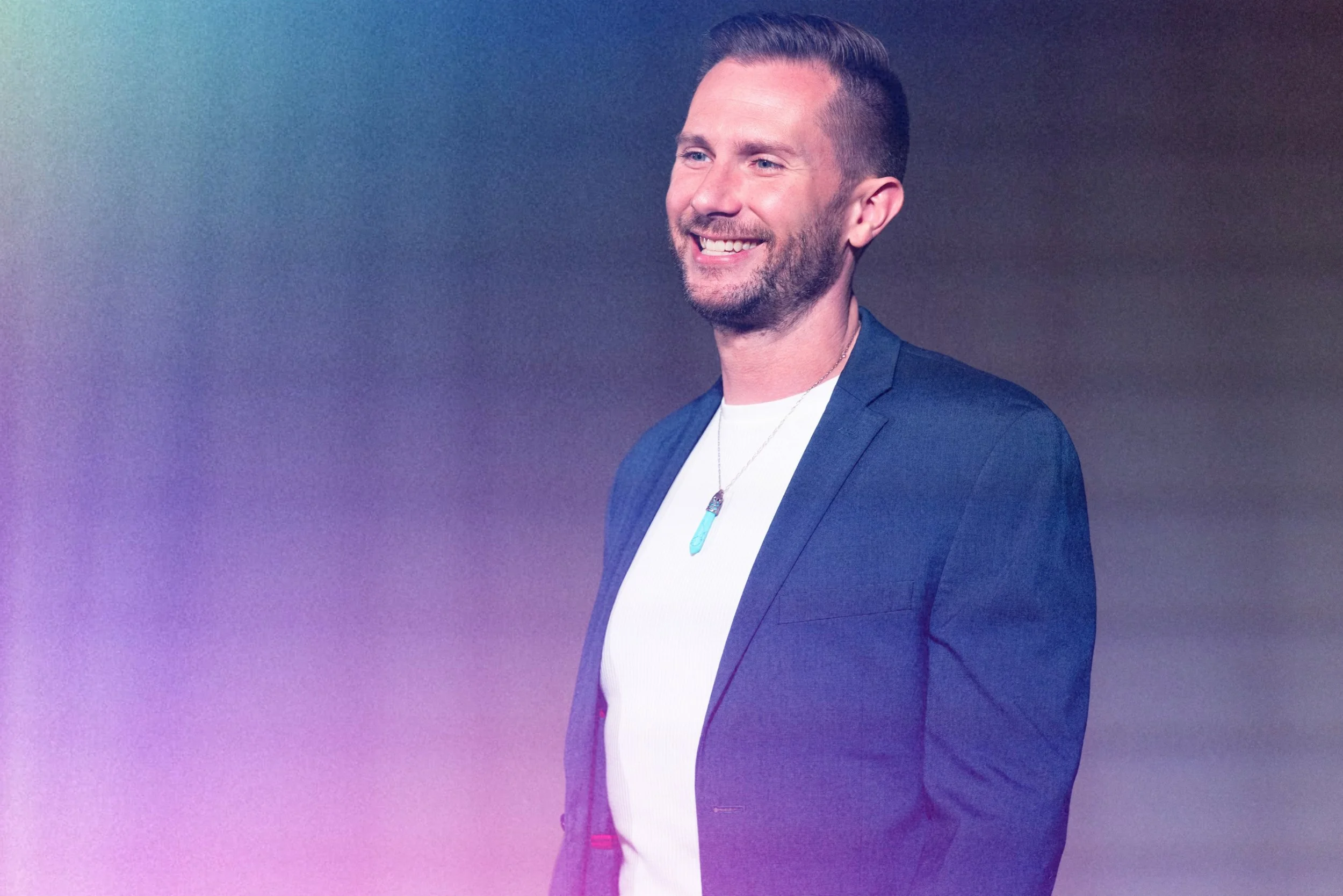
Meet Garet
Executive Transformation Coach, Best-Selling Author, and Keynote Speaker
Certifications


my Story
I’m a mid-80s kid, who grew up just south of Atlanta, into a family that worked hard for everything we had. We weren’t poor, but we weren’t comfortable either. My parents were always working, sometimes multiple jobs at once, and the church was a central part of our lives. We were there multiple days a week, and that pillar in our lives shaped everything: how we behaved, what we believed, and what was considered acceptable.
And from a very young age, I knew something about me didn’t fit.
I didn’t have the language for it at six or seven years old, but I knew I was different. While other boys were interested in girls, I didn’t want to kiss a girl classmate on the hand in first grade when we were playing truth or dare. In the environment I was growing up in, being gay wasn’t something you explored, it was something you buried. So I learned how to do that well. I learned how to adapt, how to stay within the lines, how to become who I needed to be in order to belong. Life turned into a performance.
There’s a moment I still remember clearly. I was in my early teens, sitting in the car with my mom on the way to band practice, when she made a comment about not having “sissy boys” in the family. It wasn’t said with the intention it landed with, but it reinforced the requirement to continue performing as a fake version of myself. The parts of me that already felt unacceptable started to dim their light. And once you internalize that, it changes how you move through the world.
At the same time, I found ways to function, and even lead, within that tension. In high school, I stepped into roles like drum major and yearbook editor. I was capable, driven, and responsible, but I was always managing how much of myself I allowed people to see.
Around that same time, I started volunteering with the fire department. Initially, it was a way to get out of the house, and it quickly became something more. Healthcare ran in my family, my mother and grandmother were both nurse practitioners, and once I started riding along on the ambulance, I knew I wanted to pursue it seriously.
That path led me into a career as a paramedic, and eventually into working in the ER at a pediatric Level 1 trauma center.
That experience shaped me in ways I didn’t fully understand at the time.
I was in my twenties, and because of my experience prior to the ER, I was often pulled into the most critical cases, the sickest kids, the ones no one else wanted to handle. I became very good at showing up in those moments. Calm. Focused. Capable.
But I was also absorbing the tense emotions that come along with those high stakes situations.
There was a stretch where I was exposed to multiple pediatric deaths in a short period of time, and something in me reached its limit. I didn’t have the tools or the support to process what I was carrying, and instead of recognizing that, the environment labeled me as the problem.
That moment forced a shift.
It pushed me out of that world and into a different chapter, one where I began working in healthcare technology, consulting, and leadership. I moved into roles where I was elbow to elbow with health systems, executives, and large organizations, helping them improve operations, lead teams, and navigate complex challenges.
From the outside, it looked like progress.
And in many ways, it was. I gained experience in leadership, change management, and high-level decision-making. I worked with executives, mentored leaders stepping into major roles, and got a front-row seat to how large systems actually function.
What I saw in those environments changed how I thought about leadership.
I saw people in positions of power who were burned out, disconnected, and often emotionally absent, making decisions without being fully present that impacted thousands of people.
And I recognized something uncomfortable in that.
Because despite everything I had accomplished, I was still carrying the same unresolved patterns. I was still disconnected in ways I didn’t fully understand yet.
For a long time, I coped by staying in motion. Working. Achieving. Pushing forward.
And when there was space, I checked out.
Alcohol became a way to manage what I wasn’t dealing with. Not in a way that was obvious from the outside, but enough that it kept me from having to sit with what was underneath.
That worked until life forced me to stop.
In 2020, everything slowed down at once. My dad’s health declined, and I had the opportunity to be there with him in the final stage of his life. Unlike the traumatic deaths I had witnessed in the hospital, his passing was different. It was intentional. Grounded. There was space for presence, for family, for closure.
For the first time, I experienced death in a way that felt complete.
And it changed me.
Not long after, I found myself in a period of isolation, grief, and uncertainty. With everything stripped back, I no longer had the same ways of avoiding what I was feeling. And for the first time, I had to actually face it in the mirror.
That’s when I was introduced to psychedelic work as a tool that provided a layer of safety to begin dropping the performance.
It helped me process grief. It helped me understand the patterns I had been living in for years. It showed me how disconnected I had been from myself, and how much of my life had been shaped by avoidance.
More importantly, it showed me that insight alone isn’t enough.
Real change requires integration.
It requires building a different relationship with yourself. Making different decisions. Taking responsibility for how you show up.
And I didn’t get that right immediately.
I had moments where I earned lessons the hard way. Those lessons showed me what’s possible, and what working with psychedelics actually demands
Through what I learned, I approach this work more intentionally. More honestly.
And then, in 2022, my mom was diagnosed with metastatic breast cancer.
By that point, I had done enough of my own work to show up in a way I hadn’t been able to earlier in my life. I wasn’t avoiding. I wasn’t numbing. I was present.
I had the opportunity to have the conversations that matter. To ask the questions I had never asked. To hear things from her that I had spent years wondering about.
Her passing was incredibly difficult. But it was also, in a way, grounding.
There was a level of completeness to it. A sense that nothing meaningful had been left unsaid.
And that experience reinforced something I had been learning over time:
You don’t wait until the end of life to get honest.
You don’t wait until things fall apart to start paying attention.
You do the work now.
At that point, something became very clear.
I couldn’t keep operating the way I had before. I couldn’t stay in environments where people were leading from disconnection. And I couldn’t ignore everything I had learned, through healthcare, through leadership, and through my own experiences with loss, burnout, and transformation.
So I made a decision to build something different.
To take everything I had lived through and turn it into work that helps people change, not just think differently, but live differently in a sustainable way.
The way I work today reflects that.
I don’t treat people as problems to fix. I don’t start with a single issue and try to solve it in isolation. I look at the whole system.
We start with the foundation of sleep, nutrition, movement, nervous system regulation, and relationships, because if your body isn’t supported, nothing else is going to hold. From there, we go deeper into patterns, behaviors, and the internal dynamics that shape how you show up in your life and work.
And when it’s appropriate, psychedelic work becomes part of the process, not as the center of it, but as a tool, used intentionally and with respect.
My role is not to tell you what to do.
It’s to help you understand yourself well enough that you can make your own decisions, with clarity, confidence, and a level of self-trust that most people never develop.
Most of the people who come to me are at a point where something has to change.
They’ve tried different approaches. They’ve done the work. They’re not looking for another quick fix.
They’re ready to do something real.
If that’s where you are, I’ll meet you there.
It’s time to put you first, for once.